
How Does a Transmission Work? A Practical Guide for DIYers and Auto Enthusiasts
Introduction to Transmission Systems
A transmission is one of the most essential components of any vehicle’s drivetrain. Its main job is to ensure the right amount of power goes to your wheels to drive at any given speed. Without a functioning transmission, a vehicle cannot operate efficiently—if at all.
What is a Transmission and Why It Matters
In simple terms, a transmission transfers power from the engine to the wheels. It adjusts this power through gear ratios, enabling your car to accelerate, climb hills, or cruise efficiently. Think of it as the intermediary that balances engine output with road speed, making modern driving smooth and controlled.
The Role of Transmissions in Performance and Fuel Economy
A properly functioning transmission allows your engine to work within its optimal RPM range. This helps conserve fuel, improve acceleration, and reduce engine strain. Performance-oriented vehicles rely heavily on advanced transmission designs to maximize speed and responsiveness, while hybrids and economy cars use efficient gear transitions to boost mileage.
Types of Automotive Transmissions Explained
Manual Transmissions and Clutch Operation
Manual transmissions require the driver to engage the clutch pedal and manually select gears. They use a flywheel, clutch disc, and pressure plate to engage or disengage power. This system provides more control and is favored by driving purists, though it requires skill and timing.
Automatic Transmissions: Torque Converters and Planetary Gears
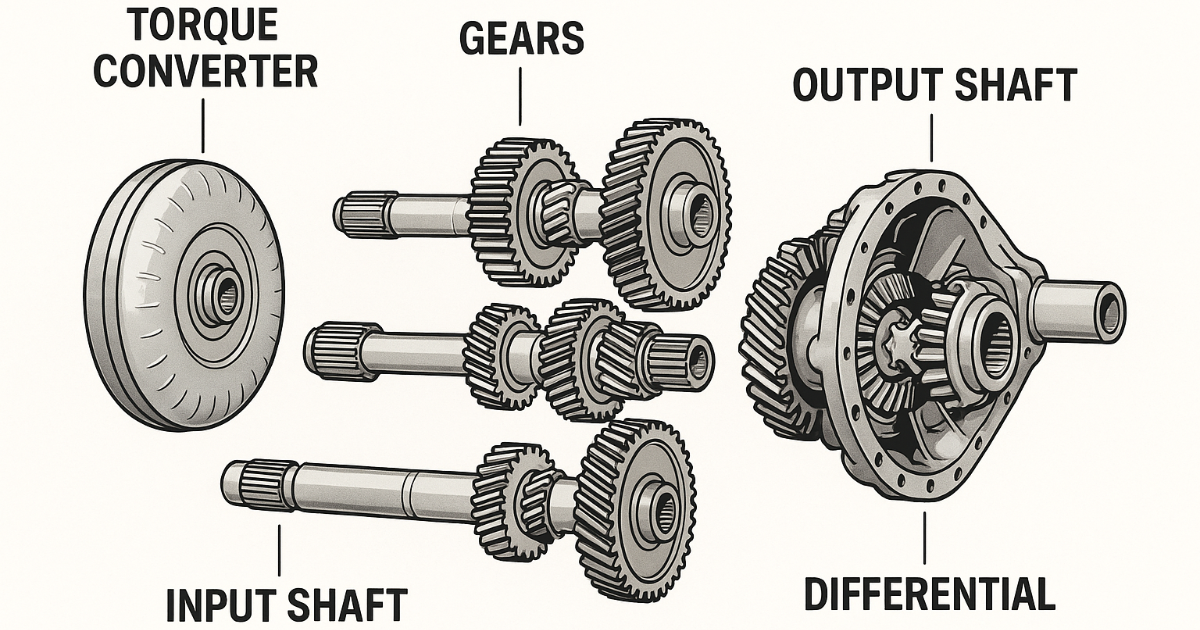
Automatic transmissions shift gears for you. A torque converter replaces the clutch to manage power flow, while planetary gear sets provide a wide range of gear ratios. Modern automatics offer smooth transitions and are increasingly efficient thanks to electronic controls.
CVT (Continuously Variable Transmission) Functionality
CVTs don’t use gears in the traditional sense. Instead, they rely on pulleys and belts to offer seamless ratio changes. This allows for smoother acceleration and better fuel economy, though performance enthusiasts sometimes critique their “rubber band” feel.
Dual-Clutch and Semi-Automatic Systems
Dual-clutch transmissions (DCTs) use two separate clutches for odd and even gears, enabling lightning-fast gear changes. Semi-automatics blend manual and automatic functionality, often controlled by paddle shifters. These systems are popular in high-performance cars for their rapid response.
Core Components Inside a Transmission
Gears, Shafts, Synchronizers, and Shift Forks
At the core of every transmission are its gears and shafts, which determine torque and speed. Synchronizers match gear speeds for smooth transitions, while shift forks move the gears into place. These mechanical interactions are the backbone of every gear shift.
Transmission Fluid and Its Importance
Transmission fluid lubricates internal parts, helps with cooling, and allows for hydraulic function in automatics. Low or dirty fluid can lead to overheating, shifting problems, and internal damage. Regular checks and fluid changes are essential for long-term health.
Transmission Control Modules (TCMs) in Modern Vehicles
Modern transmissions are electronically controlled by a TCM, which communicates with the vehicle’s engine control unit (ECU). It reads sensor data to optimize shift points, detect problems, and improve efficiency. Faulty TCMs can trigger shifting issues and warning lights.
How Power Moves Through a Transmission System
Power Flow from Engine to Wheels
The engine creates rotational energy that travels through the clutch or torque converter to the transmission. From there, it passes through selected gears and down the driveshaft to the differential, which finally distributes power to the wheels.
Gear Selection and Shift Patterns
Each gear ratio changes the balance between torque and speed. Lower gears offer more torque for acceleration, while higher gears reduce engine RPM at cruising speeds. Whether you’re shifting manually or letting an automatic transmission decide, each gear has a defined pattern designed for efficiency.
Final Drive and Differential Involvement
The final drive is the last gear reduction before power reaches the wheels. It works with the differential to allow wheels to rotate at different speeds during turns. Transmission and differential compatibility is critical—especially when sourcing replacements or upgrades from our experts at Malouf XParts.
Common Signs of Transmission Issues
Slipping Gears and Delayed Shifting
If your car unexpectedly changes gears or hesitates during acceleration, you may be experiencing gear slip. This could be due to worn clutch plates, low fluid, or electronic control malfunctions.
Transmission Fluid Leaks and Burning Smells
Spots of red or brown fluid under your vehicle often indicate a leak. If you smell something burnt while driving, it may be overheated transmission fluid—a sign that urgent maintenance is needed.
Dashboard Warning Lights and Diagnostic Codes
Many modern vehicles monitor transmission health electronically. If your check engine light or transmission warning icon comes on, scanning for error codes can reveal issues with solenoids, sensors, or fluid pressure. Some of these problems can be resolved by replacing components available from Malouf XParts.
Maintaining Your Transmission for Longevity
Checking and Changing Transmission Fluid
One of the most important tasks is monitoring fluid levels. Use the dipstick (if available) and change the fluid according to your owner’s manual schedule. Be sure to use OEM-recommended fluids or trusted equivalents from Malouf XParts.
Keeping the Transmission Cool
Transmission heat is a leading cause of failure. Make sure your cooling system is functioning, and consider adding a transmission cooler if you tow frequently or drive in hot climates. Heat-resistant components from reliable parts providers can prevent long-term damage.
Software Updates and Electronic Checks for Modern Transmissions
Newer vehicles often benefit from TCM software updates. Visit your dealership or trusted repair shop to ensure your system is running the latest firmware. For electronic components, sourcing sensors and solenoids from reputable suppliers like Malouf XParts helps maintain system integrity.
When to Replace or Rebuild Your Transmission
Rebuild vs. Replacement Cost and Labor Considerations
Rebuilding a transmission can restore performance at a lower cost than replacement, but it requires specialized labor and clean-room conditions. Full replacements, though costlier, offer faster turnaround and peace of mind if you purchase a quality remanufactured unit.
Remanufactured vs. New Transmission Parts
Malouf XParts carries both remanufactured transmissions and OEM-quality replacement components, offering solutions for professional shops and advanced DIYers. Choosing reman parts can save money while retaining high reliability.
Where to Find Quality Transmission Components at Malouf XParts
For a comprehensive catalog of transmission parts—including clutches, torque converters, fluids, and full assemblies—visit Malouf XParts’ Transmission Center. Their expert staff and nationwide shipping make sourcing the right part easy.
Final Thoughts: Demystifying Transmissions for DIY and Pro Repair
Why Transmission Knowledge Empowers Vehicle Owners
The more you know about your drivetrain, the better you’ll recognize symptoms and perform basic maintenance tasks. This saves you time and helps avoid costly repair surprises.
Resources for Parts, Upgrades, and Diagnostics
For expert parts sourcing, warranty-backed components, and ongoing support, trust Malouf XParts as your go-to resource for transmission and drivetrain repair.